
A deep clean kitchen appliances checklist covers the five appliances most homeowners skip during a standard clean: the oven interior, refrigerator (including condenser coils), dishwasher filter, microwave, and range hood filter. For most Wheat Ridge households, a full pass every three to four months keeps appliances running efficiently, but some components need monthly attention.
We already published a full guide on how to deep clean your stovetop. This post covers the other five appliances your stovetop guide doesn't touch, and together they form a complete kitchen deep cleaning plan.
- A complete kitchen appliance deep clean covers the oven interior, fridge coils, dishwasher filter, microwave, and range hood filter on separate schedules.
- Only 32% of people sanitize surfaces used to prepare raw meat, per USDA research, which means refrigerator handles and oven knobs are common cross-contamination points.
- Wheat Ridge ranch homes built in the 1950s through 1970s often have bottom-coil refrigerators where condenser coils sit behind a front grille, not behind the unit.
- About 24% of Clearview’s service requests are specifically for deep cleaning, making it the third most-requested service we offer.
- Monthly range hood filter cleaning reduces grease buildup that is a documented residential fire risk.
Why a Deep Clean Kitchen Appliances Checklist Matters for Food Safety
Cleaning kitchen appliances on schedule is a food safety measure, not just a cosmetic one. According to USDA Food Safety and Inspection Service research, only 32% of people clean and sanitize the surface they used to prepare raw meat, and 11% of participants contaminated their refrigerator handles during raw meat prep. Those bacteria colonies thrive in warm, neglected appliance interiors.
Here's the thing. Most of us wipe down countertops after cooking but skip the oven knobs, the fridge door gasket, and the dishwasher filter entirely. Over weeks and months, grease, food particles, and moisture create conditions where bacteria multiply in places you can't see.
The CDC's food safety guidelines recommend regular cleaning of all food-contact surfaces, and that includes the inside of your refrigerator, your microwave turntable, and your oven racks. A structured checklist helps you cover each appliance on the right schedule without guessing.
For Wheat Ridge homeowners specifically, Colorado's dry climate means dust accumulates faster on mechanical components like refrigerator condenser coils. Our team sees this pattern regularly when we provide Wheat Ridge cleaning services, and it contributes to higher energy bills and shorter appliance lifespans.
The Five-Appliance Deep Clean Checklist
Below is the core of this deep clean kitchen appliances checklist. We have organized it by appliance, with step-by-step instructions and a recommended frequency for each task. Grab a spray bottle of white vinegar, baking soda, dish soap, a soft brush, and microfiber cloths before you start.
Step 1: Oven Interior
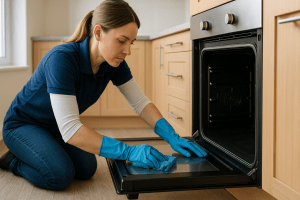
The oven interior collects baked-on grease and carbonized food that standard wiping won't remove. A baking soda paste applied overnight is the safest and most effective approach for most home ovens.
- Remove oven racks and soak them in hot water with dish soap for at least two hours (a bathtub works well for this).
- Mix a paste of 1/2 cup baking soda and 2 to 3 tablespoons of water. Spread it across the oven interior, avoiding the heating elements.
- Let the paste sit for 12 hours or overnight.
- Wipe out the paste with damp microfiber cloths. For stubborn spots, spray white vinegar on the residue and wipe again.
- Clean the oven door glass inside and out, and wipe the door gasket (the rubber seal) with a damp cloth.
- Scrub oven racks with a brush, rinse, dry, and replace.
One note for Wheat Ridge homeowners: if your home was built in the 1960s or 1970s and still has the original range, be cautious with the self-clean cycle. The extreme heat (around 900 degrees Fahrenheit) can stress older heating elements and door locks. The baking soda method is gentler on vintage appliances.
Frequency: Every 3 months, or immediately after a significant spill or boil-over.
I had a client last year in a 1965 Wheat Ridge ranch who hadn't cleaned her oven in over two years. The carbon buildup was so thick it was actually affecting the oven's temperature accuracy. After our team did a full deep clean, she said her cookies finally baked evenly again. That kind of buildup is more common than people realize.
Step 2: Refrigerator, Including Condenser Coils
Cleaning your refrigerator means more than wiping shelves. The condenser coils, door gaskets, and crisper drawers all need attention on separate schedules. The FDA recommends keeping your fridge at 40 degrees Fahrenheit or below, and dirty coils force the compressor to work harder to maintain that temperature.
Interior cleaning:
- Remove all food and check expiration dates.
- Take out removable shelves and drawers. Wash them with warm, soapy water.
- Wipe interior walls and the ceiling of the fridge with a solution of 2 tablespoons baking soda dissolved in 1 quart of warm water.
- Clean door gaskets with warm soapy water and dry thoroughly (mold grows in damp gaskets).
- Wipe down the exterior, including handles, where the USDA FSIS research found 11% of people transfer raw meat bacteria.
Condenser coil cleaning:
- Locate your coils. This is where Wheat Ridge's housing stock matters. Many of the mid-century ranch homes built in the 1950s through 1970s have bottom-coil refrigerators where the condenser coils sit behind a front grille at the base of the unit, not behind the refrigerator. You can pop off the grille by pulling it forward or releasing simple clips.
- Vacuum the coils with a brush attachment or use a dedicated coil brush (available at most hardware stores for under ten dollars).
- If your coils are behind the unit, carefully pull the fridge out from the wall, unplug it, vacuum the coils, and push it back.
Frequency: Interior wipe-down every 3 months. Condenser coils every 6 months. Door gaskets monthly (a quick check for crumbs and mold).
We offer "inside fridge" as a specific deep cleaning service add-on because so many clients ask for it. It is one of Clearview's most frequently booked add-ons, along with inside oven cleaning, because these are the tasks homeowners either don't have time for or don't feel confident tackling alone.
Step 3: Dishwasher Filter and Interior
Most modern dishwashers have a removable filter at the bottom of the tub that traps food particles. If you have never cleaned it, that filter is likely clogged with decomposing food, which causes bad odors and poor cleaning performance.
- Open your dishwasher and remove the bottom rack.
- Locate the filter (usually a cylindrical piece near the center or back of the tub floor). Twist it counterclockwise and lift it out.
- Rinse the filter under warm running water. Use a soft brush (an old toothbrush works) to scrub away trapped food.
- While the filter is out, wipe down the filter housing area, the spray arms (check the small holes for clogs), and the door seal.
- Run an empty cycle with 2 cups of white vinegar placed in a dishwasher-safe bowl on the top rack.
Frequency: Rinse the filter monthly. Full interior deep clean (including the vinegar cycle) every 3 months.
So many homeowners tell us they had no idea their dishwasher even had a removable filter. If your dishes come out with a film or your dishwasher smells musty, the filter is the first thing to check.
Step 4: Microwave Interior and Exterior
The steam method is the simplest way to loosen caked-on food inside a microwave. A bowl of water with a splash of vinegar, heated for three minutes, creates steam that softens splatter so you can wipe it away without scrubbing.
- Fill a microwave-safe bowl with 1 cup of water and 2 tablespoons of white vinegar.
- Microwave on high for 3 minutes. Let it sit with the door closed for 2 more minutes (the steam needs time to work).
- Carefully remove the bowl. Wipe the interior walls, ceiling, turntable, and door with a damp microfiber cloth.
- Remove the turntable and wash it in the sink with warm soapy water.
- Wipe the exterior, paying attention to the touchpad and handle (high-touch surfaces that collect grease and bacteria).
- Clean the vents on the top or back of the microwave to prevent grease buildup.
Frequency: Quick interior wipe monthly. Full deep clean (steam method plus exterior and vents) every 3 months.
Step 5: Range Hood Filter
Range hood filters trap airborne grease from cooking, and neglected filters are a documented fire hazard. If your filter looks discolored or feels sticky, it is overdue for cleaning.
But here is the thing most people miss: cleaning the visible surface of your range hood is not the same as cleaning the filter inside it.
- Turn off the range hood. Remove the filter(s), which are usually metal mesh or baffle-style panels held in by clips or a sliding mechanism.
- Fill your sink with very hot water. Add 2 to 3 tablespoons of dish soap and 1/2 cup of baking soda. Submerge the filter and let it soak for 15 to 20 minutes.
- After soaking, scrub both sides with a soft brush. Rinse thoroughly and let it dry completely before reinstalling.
- While the filter is out, wipe the interior of the hood with a degreasing spray and a microfiber cloth.
Wheat Ridge ranch homes from the 1950s through 1970s sometimes have older baffle-style range hood filters that are thicker and heavier than modern mesh filters. These baffles actually clean up well with the soak method, but they may need a longer soak time (30 minutes instead of 15). If your range hood vents to the outside (common in older homes), check the exterior vent cap for grease buildup as well.
Frequency: Monthly if you cook regularly (four or more times per week). Every 3 months for lighter kitchen use. HomeAdvisor recommends monthly cleaning for any household that does regular stovetop cooking.
Quick-Reference Cleaning Frequency Table
Use this table to set recurring reminders so you never fall behind on appliance maintenance. The frequencies below reflect industry standards from the USDA, FDA, and our own experience cleaning hundreds of Denver-metro kitchens.
| Appliance | What to Clean | How Often |
|---|---|---|
| Oven interior | Baking soda paste, racks soak, door gasket | Every 3 months (or after spills) |
| Refrigerator interior | Shelves, drawers, walls, door gaskets, handles | Every 3 months |
| Refrigerator condenser coils | Vacuum or brush coils (front grille or rear) | Every 6 months |
| Dishwasher filter | Remove, rinse, scrub; vinegar cycle | Monthly rinse, quarterly deep clean |
| Microwave | Steam clean interior; wash turntable; wipe exterior and vents | Monthly wipe, quarterly deep clean |
| Range hood filter | Soak in hot soapy water with baking soda; scrub and dry | Monthly (regular cooks), quarterly (light use) |
For the complete stovetop cleaning guide (burners, grates, drip pans, knobs), see our companion post on how to deep clean your stovetop.
DIY vs. Hiring a Pro: When to Call Clearview
Most routine appliance maintenance is manageable on your own if you follow the checklist above. But there are specific situations where hiring a professional deep cleaning team saves you time, protects your appliances, and delivers a better result.
You can handle these yourself:
- Monthly dishwasher filter rinses and microwave steam cleans
- Quarterly fridge interior wipe-downs
- Routine range hood filter soaks
- Condenser coil vacuuming if you can access the coils easily
Consider calling a professional when:
- Your oven has years of baked-on carbon that a single baking soda treatment won't remove
- Your refrigerator coils haven't been cleaned in two or more years (we sometimes find coils matted with dust and pet hair so thick the compressor is overheating)
- You are prepping your home for sale and need every appliance to look its best for showings, similar to what we cover in our guide on how to deep clean your house before listing it
- You have just finished a kitchen renovation and grease, drywall dust, or construction debris is coating every surface, including inside appliances
- You are moving into a new home and want every appliance sanitized before you unpack your groceries
At Clearview, we actually require a deep cleaning service for all first-time homes before starting recurring service. That policy exists because we have seen firsthand how much hidden grime accumulates in appliances that haven't been deep cleaned in years.
Notes for Wheat Ridge Homeowners
Wheat Ridge's housing stock is predominantly mid-century ranch homes built between the 1950s and 1970s, and that matters for kitchen appliance cleaning. Older appliances and older home configurations create specific cleaning challenges that a generic national checklist won't address.
A few things our team has learned from years of cleaning Wheat Ridge homes:
- Bottom-coil refrigerators are far more common in Wheat Ridge than in newer Denver suburbs. If you have never seen condenser coils on your fridge, check the front grille at the bottom of the unit before assuming your fridge "doesn't have accessible coils."
- Older range hoods may vent directly outside through the wall. Check the exterior vent for grease accumulation, especially after winter when windows stay closed and cooking steam recirculates more.
- Colorado's dry winters mean more time spent indoors and more home cooking. January and February are excellent months to do a full appliance deep clean, since you have likely been using your oven and range hood more heavily during the holiday season.
If you are a Wheat Ridge homeowner looking for help with any of these tasks, our Wheat Ridge cleaning services page has details on what we offer in your area.
The Colorado State University Extension FoodSmart Colorado program also offers a printable kitchen cleanse checklist that pairs well with the appliance-specific guide above.
Frequently Asked Questions
What should I include on a kitchen deep clean list?
A thorough kitchen deep clean list covers countertops, sink, stovetop, oven interior, refrigerator (including coils), dishwasher filter, microwave, range hood filter, cabinet fronts, backsplash, and floors. The five appliances in this checklist are the ones most commonly skipped during routine cleaning.
How often should you deep clean kitchen appliances?
Most kitchen appliances benefit from a deep clean every three months. Exceptions include dishwasher filters (monthly rinse) and refrigerator condenser coils (every six months). Range hood filters need monthly attention if you cook on the stovetop regularly.
What products should I use to deep clean kitchen appliances?
Baking soda, white vinegar, dish soap, and warm water handle nearly every kitchen appliance cleaning task. A soft brush or old toothbrush helps with dishwasher filters and oven racks. Avoid abrasive scrubbers on stainless steel and glass surfaces.
Is it worth hiring a professional to deep clean a kitchen?
Professional deep cleaning makes sense when appliances have years of buildup, when you are preparing to sell your home, or after a renovation. A professional team has commercial-grade tools and experience that make a visible difference on heavily soiled ovens, neglected fridge coils, and grease-caked range hoods.
What is the hardest kitchen appliance to deep clean?
The oven interior is typically the most labor-intensive because baked-on carbon requires overnight treatment and multiple rounds of wiping. Range hood filters with heavy grease buildup are a close second, especially in homes where the filter has not been cleaned in over a year.
If your kitchen appliances need more attention than a weekend DIY session can deliver, we are here to help. Our team handles everything from inside-oven scrubbing to condenser coil cleaning as part of Clearview's deep cleaning packages. You can request your free estimate or call us at (720) 766-4488 to talk through what your kitchen needs.